i. What is a Solar Eclipse?
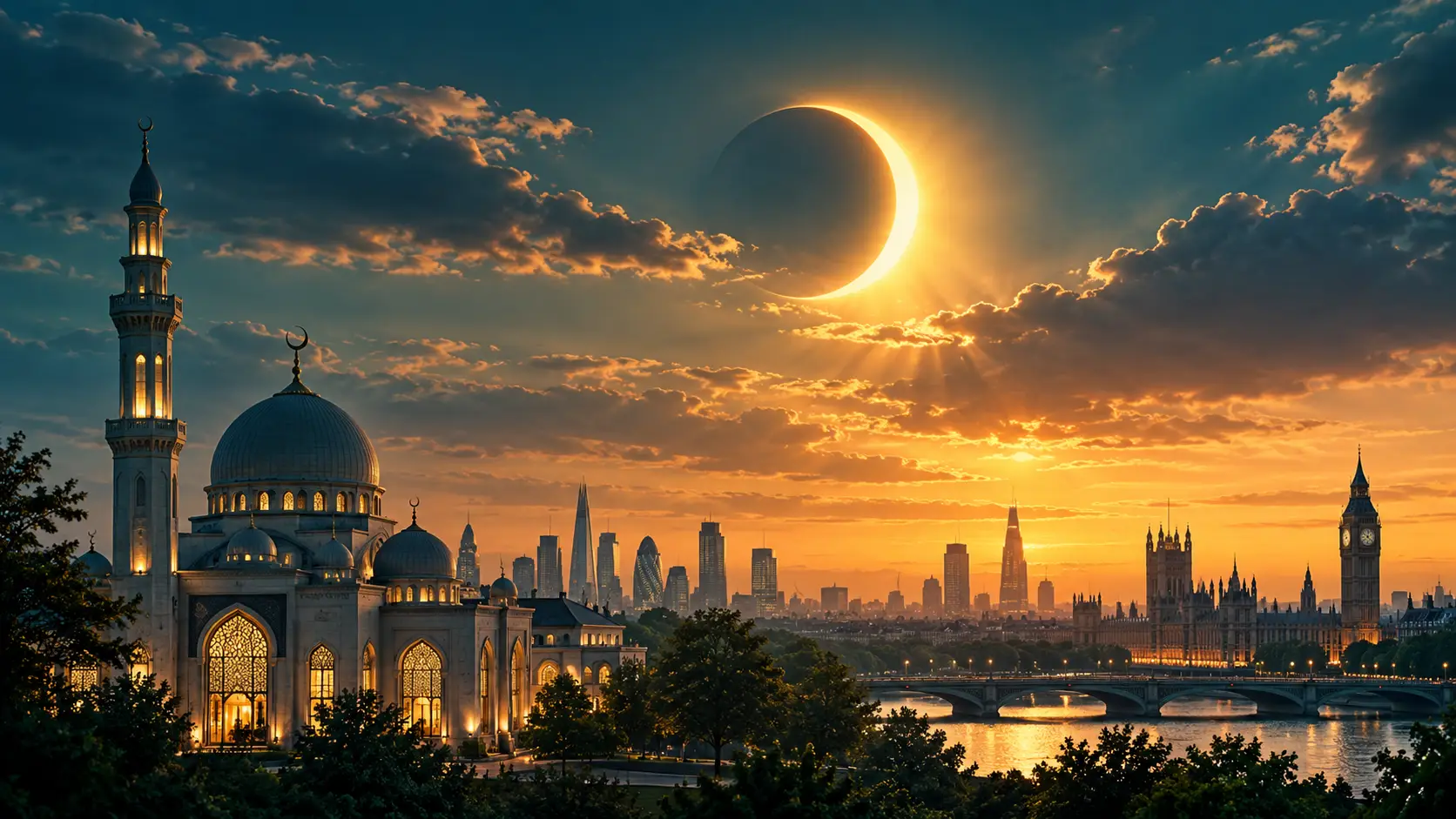
A solar eclipse happens when the Moon comes in between the Sun and the Earth and casts a huge shadow onto the Earth. A total eclipse is rare but when it happens, the Sun seems to disappear from the sky and for a few moments, everything becomes cold and dark.
A lunar eclipse is when the earth is in between the Sun and the Moon.
ii. Islam on the Solar Eclipse
All ancient cultures had their own views on a solar eclipse. Because it leads to darkness, many saw this as a bad omen. In the time of Ignorance (Jāhiliyya) the Arabs believed that a solar eclipse occurred upon the death of someone important, or to warn of a forthcoming calamity.
In the time of Prophet Muhammad ﷺ, there was a solar eclipse just after his son Ibrāhīm passed away. This reinforced the suspicion that this phenomenon occurred when someone important passed away. However, the Prophet ﷺ reassured Muslims this was not the case, but rather it is a sign of Allāh’s power and might. He said,
Verily the Sun and the Moon do not eclipse on the death of someone nor their birth. But rather they are signs from the signs of Allāh. So when you see an eclipse, perform Salāh (Sahīh Muslim).
Certainly, as our Prophet ﷺ indicated, a solar eclipse is a sign from Allāh, which highlights His perfection and precision. The Sun is four hundred times bigger than the Moon. However, because the Moon is four hundred times closer to earth than the Sun, they both look the same size from Earth and the Moon – during a solar eclipse – can cover the Sun completely. Moreover, because of the precise movement of the Sun and the Moon, scientists can predict the exact timing and places of an eclipse. This is only possible thanks to Allāh’s wonderful precision. The Qur’an states,
And the Sun runs on its fixed course for a term (appointed). That is the decree of the Almighty, the All-Knowing (36: 38).
Experts tell us that a total eclipse cannot last for more than 7 minutes 31 seconds. In the last one thousand years, less than ten solar eclipses have lasted more than seven minutes. The next solar eclipse to occur lasting more than seven minutes will be on June 25th 2150.
With such marvel and brilliance, Allāh expects us to react in the best possible manner, by performing Salāh and engaging in His remembrance.
iii. The Solar Eclipse Prayer (Salāh al-Kusūf)
The name of the prayer for the solar eclipse is called Salāh al-Kusūf. This is the Sunna of our Messenger ﷺ. It consists of two units (Rak’āt). It is Mustahabb (preferred) for this Salāh to be performed in congregation, led by the Imam who usually leads Friday prayers. However, it can be read alone too (Radd al-Muhtār). The Imam should lengthen the Salāh; it is recommended to recite Sūrah al-Baqara in the first Rak’āt and Sūrah Ale Imrān in the second quietly. However, he can shorten the prayer and opt to prolong the Du’ā instead. The purpose is to spend the whole time of the eclipse in the service of Allāh, whether that is in Salāh or in supplication and Dhikr. The Imam should conclude with a sincere Du’ā facing the Qibla, until the sun reappears in full.
There is no Azān, Iqāma or sermon for this prayer. If the eclipse happens at a time when prayer is prohibited, then the Muslim will instead perform supplications (Du’ā), engage in Dhikr and make charitable donations.
Dr. Hafiz Ather Hussain al-Azhari
@hafiz_ather
BA Principles of Theology, al-Azhar University, Cairo, Egypt.
MA Arabic and Islamic Studies, Dar al-Ulum Muhammadia Ghawsia, Bhera, Pakistan.
BA Political Science, MPhil Theology & PhD Theology, University of Birmingham.